
Replacement driveways and widening
Concrete Driveways in Pueblo, CO
From a cracked single-car strip to a wide pad for trucks and a trailer.
- Free on-site visit to measure, check the base and look at how water drains
- A written quote that lists tear-out, base, thickness, steel, finish and sealer
- We check which building office covers your address before work is scheduled
Replacing the Driveway That Came With the House
Concrete driveways are the biggest job we do in Pueblo, and most of them are replacements. With a median home built around 1965, according to Census figures summarized by Point2Homes, a lot of Pueblo driveways are older than the people parking on them. Driveways of that era were often poured narrow, thin and without steel, for cars that weighed far less than today's trucks and SUVs. When a driveway like that breaks up, patching rarely buys much time. A new concrete driveway, built properly from the ground up, is usually the fix that lasts.
Signs it is time
- Cracks that have opened wide, or panels that have shifted so edges no longer line up
- Sections that have sunk, leaving a lip at the garage or a puddle in the middle
- A surface that has scaled, pitted or flaked over large areas after winters of freeze-thaw
- Broken edges where tires run off the side
- A driveway that tips water back toward the garage or house
- A driveway that is simply too narrow for the vehicles you own now
Built from the base up
Most driveway failures start underneath. We remove the old concrete and haul it off, then dig out soft soil and organic material until we reach firm ground. A layer of gravel base goes down and is compacted in lifts. According to HomeGuide, ordinary cars need a slab no thinner than 4 inches, campers and heavy trucks call for 5 or 6, and the edges should be thickened to 6 to 8 inches. We set the thickness to how you use the driveway, and we write it on the quote.
For reinforcement we usually use rebar on a grid, set on chairs so it ends up in the middle of the slab instead of lying on the dirt. The forms are set so the driveway drains toward the street or a yard, not toward the house or garage. Lifted, broken driveways are one of the signs of swelling clay that the Colorado Geological Survey points to, and wet soil is what makes clay move, so getting water off and away from the slab matters as much as the concrete itself.
The mix and the finish
Pueblo's average January low is 15.4 degrees, while the average January high is 48.4, per Wikipedia's Pueblo climate data. That swing means a driveway freezes and thaws over and over each winter. We order air-entrained concrete for every driveway. The tiny air bubbles give water room to expand when it freezes, which is the main defense against scaling. We finish without adding water to the surface, broom it for traction, and cut or tool control joints at spacing that matches the slab width and thickness so that shrinkage cracks follow the joint lines rather than wandering through the panels.
Aprons, approaches and the street
The section between your property line and the street is often a different story from the rest of the driveway. Curb cuts, the approach across a public sidewalk, and the apron at the gutter can fall under local rules. City of Pueblo addresses now go to the Southern Colorado Building Department, while Pueblo West and other unincorporated areas go to the Pueblo County Building Division. We check which office covers your address and whether the work at the street needs its own approval before we pour.
Widening and adding parking
Older driveways are often only one car wide. Widening means pouring a new strip alongside the old slab or replacing the whole thing so it all matches. Tying new concrete to old is possible, but if the old driveway is already cracking, it usually makes more sense to replace it all at once. We also pour side pads for a trailer, boat or RV, which need a thicker slab than a car does.
The first month
Per HomeGuide's driveway guide: people can walk on it after a day or two, a car can come onto it after a week, and a loaded pickup, camper or delivery truck should stay off for about a month. During that month, aim sprinklers away from the edges. Through the first winter, shovel or plow instead of salting. Seal it once the month is up, then again every two or three years, which cuts down on the water and salt the surface soaks up.
What a Driveway Job Includes
A replacement driveway covers everything from removing the old concrete to sealing the new surface.
Tear-out and haul-off
We break up the existing slab, whether concrete or asphalt, and truck it away.
Base and grade
Soft soil removed, gravel base placed and compacted, and the grade set so water runs away from the house.
Reinforcement
Rebar on chairs, with thickened edges where tires run along the sides.
Air-entrained pour
An exterior mix made for freeze-thaw, placed, screeded and broom finished.
Control joints
Joints cut or tooled on a planned layout so cracks stay where they belong.
Aprons and pads
Garage aprons, side parking and RV pads poured to match the main driveway.
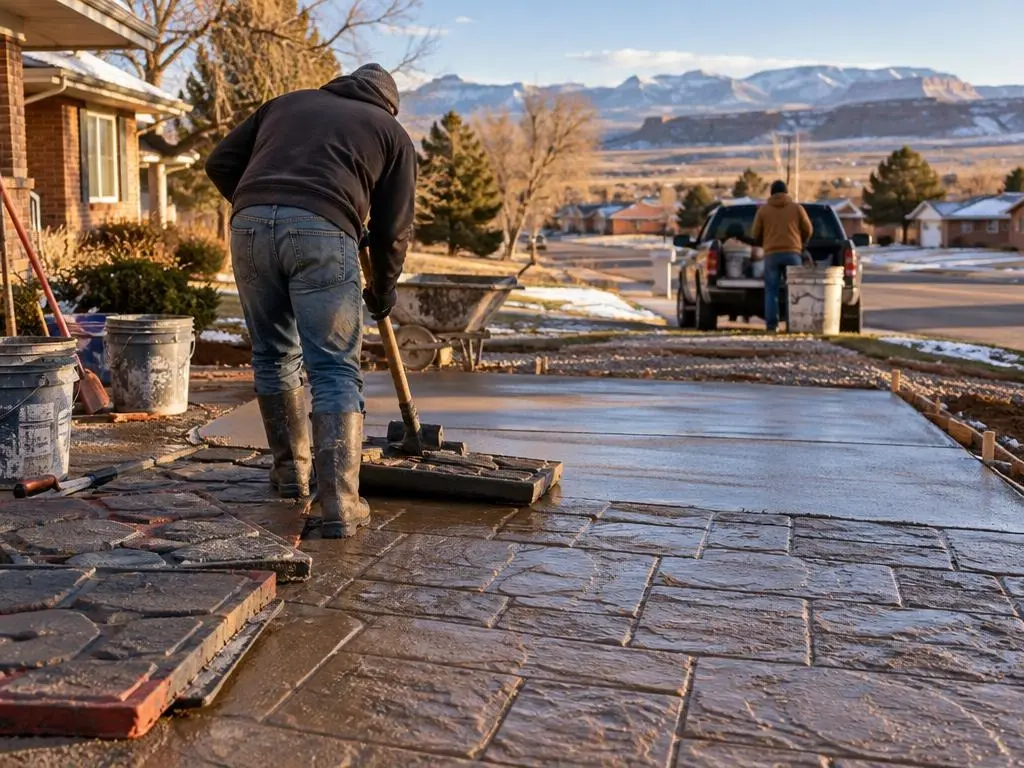
Typical Concrete Driveway Costs
| Item | Published range |
|---|---|
| Standard concrete, per sq ft | $6 to $10 |
| 1-car, 12' x 24' (288 sq ft) | $1,700 to $4,300 |
| 2-car, 20' x 20' (400 sq ft) | $2,400 to $6,000 |
| 2-car, 24' x 24' (576 sq ft) | $3,500 to $8,600 |
| Old driveway removal, per sq ft | $2 to $6 |
| Rebar, per sq ft | $1 to $3 |
| Sealing, per sq ft | $1 to $3 |
Source: HomeGuide's concrete driveway cost guide, national figures. A Pueblo job can land higher or lower depending on tear-out, base work, thickness and access. The number on your written quote is what you pay.
How a Driveway Gets Done
1. Site visit
We measure, look at the old slab and the drainage, and talk about how you use the driveway.
2. Written quote
Thickness, base, steel, joints, finish and any street work are listed with one total.
3. Tear-out and prep
Old concrete removed, base dug, compacted and formed to grade, steel set.
4. Pour and cure
Concrete placed, finished, jointed and kept moist, with dates for walking and driving.
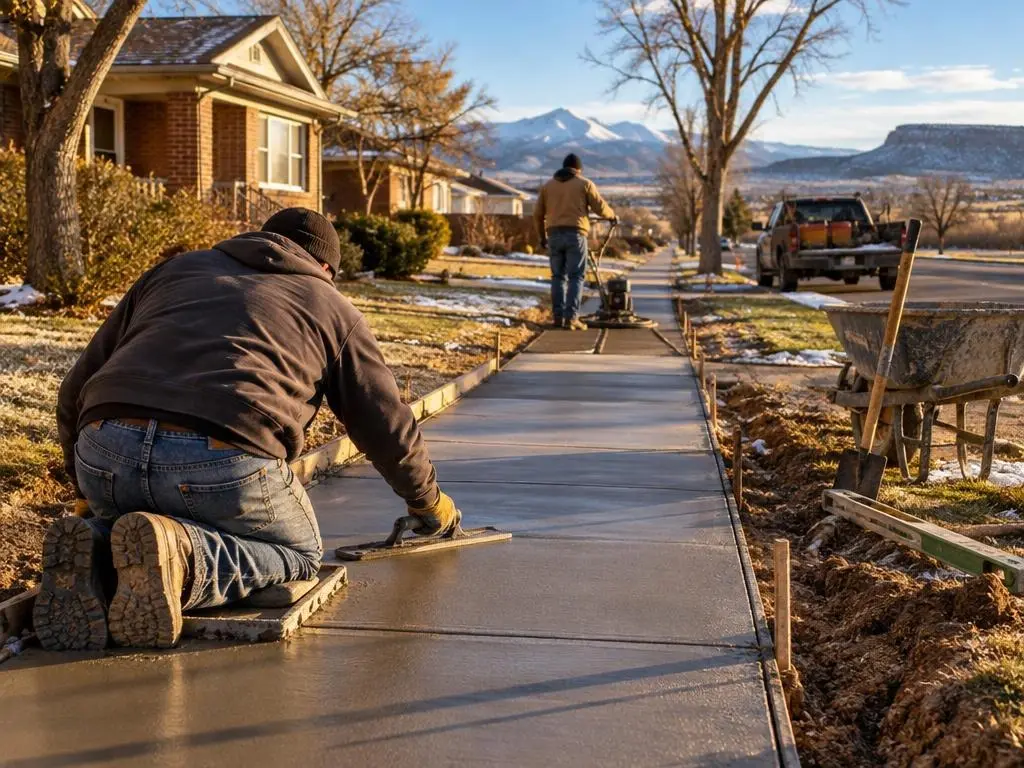
Why Choose Us for Concrete Driveways
Thickness in writing
You see the slab and edge thickness on the quote, not just a square-foot price.
Drainage set first
Forms are set so the new driveway sheds water away from the garage and house.
Concrete Driveways Questions
How thick should a driveway be in Pueblo?
At least 4 inches for cars, per HomeGuide, and 5 to 6 inches if you park a heavy truck, RV or trailer. We thicken the edges either way.
Can you pour over my old driveway?
Not as a new driveway. Pouring over cracked concrete copies the cracks into the new layer. If the old slab is sound, a thin resurfacing may be an option, which we cover on our repair page.
How long before I can park on it?
A week for an everyday car, according to HomeGuide, and about a month for anything heavy like an RV or a work truck. Your slab's dates are written down for you on pour day.
Do you remove asphalt driveways too?
Yes. We can remove an old asphalt driveway and replace it with concrete.
Should I seal a new concrete driveway?
Yes, after about a month of curing and again every two to three years. It helps keep water and salt out of the surface.
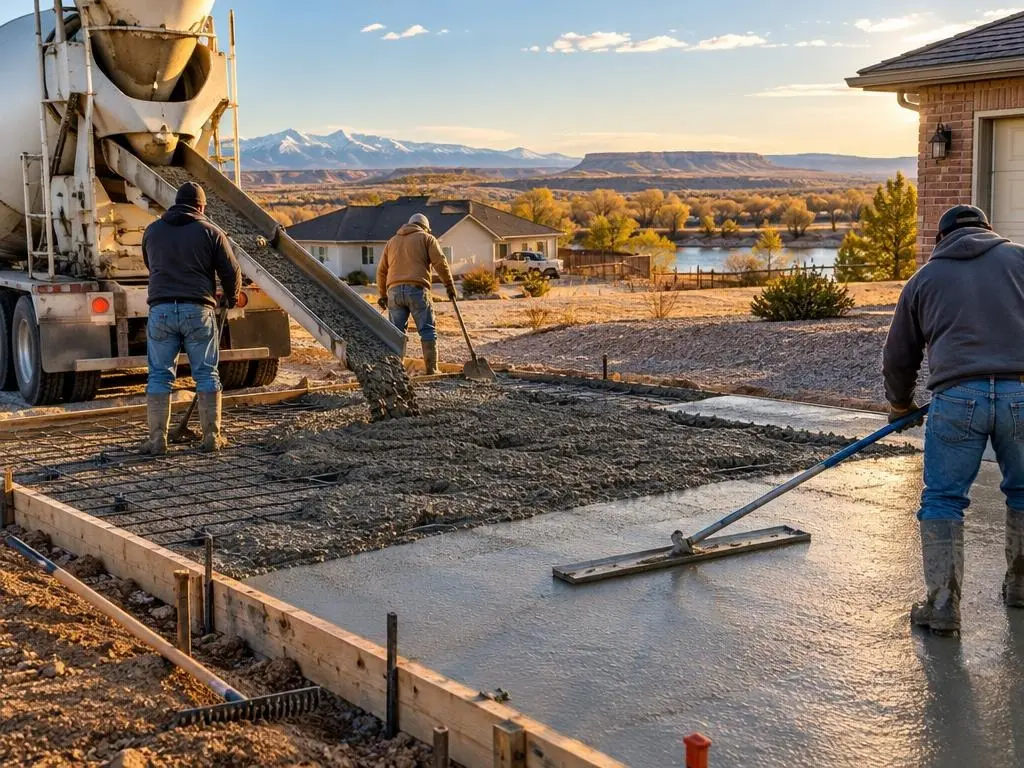
Concrete Driveways Service Areas
- Concrete Contractors in Pueblo, CO
- Concrete Contractors in Pueblo West, CO
- Concrete Contractors in Bessemer, CO
- Concrete Contractors in Colorado City, CO
- Concrete Contractors in Rye, CO
- Concrete Contractors in Cañon City, CO
- Concrete Contractors in Florence, CO
- Concrete Contractors in Penrose, CO
- Concrete Contractors in Lincoln Park, CO
- Concrete Contractors in Williamsburg, CO
- Concrete Contractors in Beulah Valley, CO
- Concrete Contractors in Avondale, CO
- Concrete Contractors in Vineland, CO
- Concrete Contractors in Blende, CO
- Concrete Contractors in Salt Creek, CO
- Concrete Contractors in Boone, CO
- Concrete Contractors in Brookside, CO
- Concrete Contractors in Rockvale, CO
- Concrete Contractors in Coal Creek, CO
- Concrete Contractors in Walsenburg, CO
Get a Concrete Driveways Estimate
Tell us the size and what the old driveway is doing, and we will come measure.